
Who Signs the Reference Sample? QC Gates in OEM and ODM Gift Sets
Every quality argument in fragrance manufacturing eventually comes back to one object: the approved reference. If the reference is unambiguous, disagreements become comparisons. If it is not, the same batch can be defended and rejected by two reasonable people. In OEM work the reference usually starts with the brand's specification; in ODM work it is created during development, and that difference decides who has to sign it.
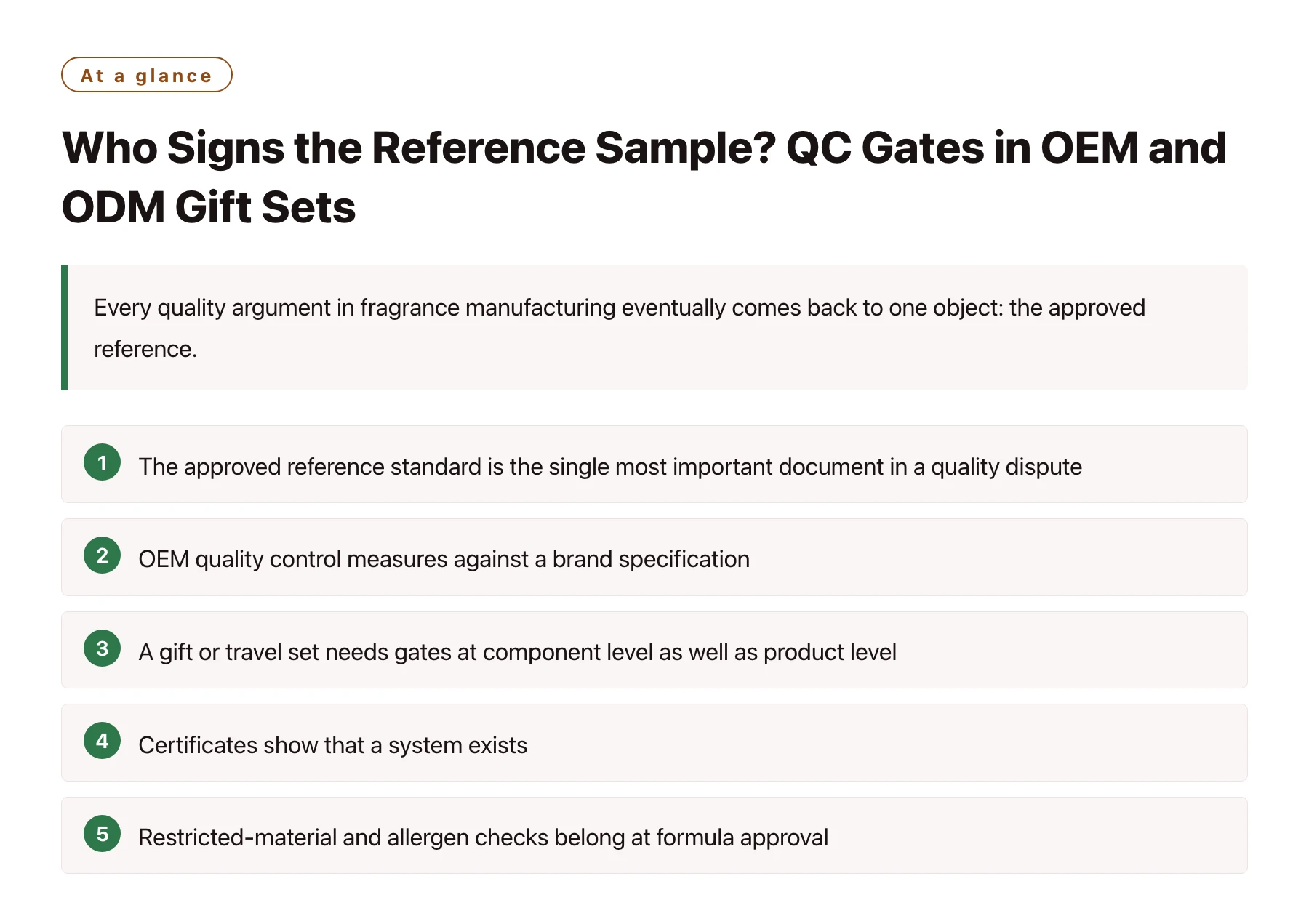
Key takeawaysThe approved reference standard is the single most important document in a quality dispute, and it should be signed by both parties before bulk production begins. · OEM quality control measures against a brand specification; ODM quality control measures against a platform standard that both sides agreed during development. · A gift or travel set needs gates at component level as well as product level, because the pack can fail where the juice was fine. · Certificates show that a system exists; batch records show that the system was applied to your order. · Restricted-material and allergen checks belong at formula approval, because catching them after filling means rework rather than adjustment.
Quality control is often described as a series of inspections, which makes it sound like a checklist that any organised factory can complete. The harder problem is deciding what the product is being compared against, and who is allowed to change that definition.
This is a walk through the gates in a fragrance production run and its packaging, with attention to how responsibility shifts between OEM and ODM projects. The gates themselves are similar; the ownership behind them is not.
The reference standard, and why it decides everything
A reference standard is the physical and documented version of the product you agreed to buy: the retained sample, its specification, the approved artwork and the component list. When a later batch arrives, quality control compares it against that record rather than against memory or a marketing photograph.
In an OEM project, the brand normally supplies or commissions the specification, so the reference exists before production. In an ODM project, the platform already exists and the brand's variant is defined during development, which means the reference is created in the process rather than arriving with it. Neither is better, but the ODM version requires an explicit sign-off step that is easy to skip when the product feels settled.
Restricted-material limits belong at this stage as well. They apply to what is in the formula rather than to who designed it, and the headroom left in the approved formula determines how much room there is for a later adjustment [1].
What a signed reference should contain
At minimum: a retained sample stored under the same conditions as production, a written specification with fill weight and tolerance, the approved artwork version, the component list with each part's source, and the date of approval. If any of those is missing, a later comparison has to be negotiated rather than performed.
It also helps to record how the sample was produced. A reference made as a hand-filled laboratory sample is useful for odour approval but weaker as a production standard, because the filling and closure steps differ from the bulk run.
Change control is the other half
A reference only holds if changes pass through a route that both parties can see. Ask how the supplier records a modification to a material, a component or a decoration process, and who approves it. A factory that can describe its change process is easier to work with than one that simply promises to inform you.
For multi-component sets, change control matters more, because a substitution in one part can pass unnoticed while the finished set still looks broadly the same.
The gates in a gift or travel set run
| Gate | What is checked | OEM ownership | ODM ownership |
|---|---|---|---|
| Incoming components | Dimensions, colour, decoration, supplier batch | Brand approves specifications; factory inspects | Factory defines platform; brand approves variant |
| Bulk compounding | Formula conformity, mixing record, odour check | Measured against the brand specification | Measured against the agreed platform variant |
| Restricted materials | Compliance of the formula as written | Brand confirms the brief constraints | Factory documents the platform position |
| Filling and closure | Fill weight, crimp, leak and spray function | Factory controls to the brand's tolerances | Factory controls to the platform tolerances |
| Decoration | Adhesion, coverage, print position | Brand-approved artwork and sample | Brand variant artwork on a platform part |
| Set assembly and final inspection | Completeness, appearance, packing | Jointly defined inspection standard | Factory standard, confirmed by the brand |
The right-hand columns show where the negotiation actually sits. In both models the factory performs the inspection; what changes is who defined the standard being inspected against. Buyers who assume the standard is obvious are usually the ones who discover a gap at the last gate.
Setting up gates that hold
- Write the reference down before bulkA signed reference sheet with sample, specification and artwork version, dated and held by both parties, prevents most disputes before they begin.
- Name the inspection standard, not just the inspectionAsk which criteria are used at each gate and how a unit is judged to pass. Where an acceptable quality limit is applied, record the level used.
- Check allergen and labelling content on the finished productDeclaration requirements follow the finished product and its category, so the check is done per pack rather than per formula [2].
- Request records tied to your batchStanding certificates describe a system. Batch records show that the system was used on your order, and they are the documents worth collecting at shipment.
- Use independent testing where it earns its placeLaboratories test stability, compatibility and microbiological quality, and third-party results are useful when a specification needs to be confirmed independently [3].
- Inspect the assembled set, not only the bottleThe final gate should look at the set as the customer receives it, including the insert, the travel unit and the outer box.
Where the two models fail differently
OEM failures are usually specification failures. The factory produced what was written down, and what was written down turned out to be incomplete: a tolerance that was never stated, a colour reference that was described in words, or a fill weight that was implied rather than specified.
ODM failures are usually expectation failures. The platform met its own standard, but the brand had imagined something slightly different and never said so in a form that could be checked. Because the product existed and looked finished, the gap was never surfaced.
Where a brand can strengthen its position
Regardless of model, the brand controls two things: how precisely it specifies and how promptly it approves. Both reduce the space in which a quality disagreement can grow, and neither requires technical expertise.
It also helps to know the supplier's manufacturing background, because a factory used to export work will have a document pack and an inspection vocabulary ready. its background and certifications is the kind of page that can be read against the records you later receive.
What premium work changes
Higher price points do not change the gates; they tighten the tolerances applied at each one. Decoration, spray function and set presentation are usually where the difference is visible, and where a small drift becomes commercially significant.
Suppliers presenting themselves as fine fragrance manufacturing are claiming tighter control, and the fair test is the same as everywhere else: ask to see the inspection criteria for a comparable project and how deviations were handled.
Gift sets amplify this because the customer handles the pack before the product. A bottle that is judged acceptable on its own may fail as a set, which is why the final gate should be run on the assembled item.
Documentation as the durable output
At the end of a successful run, the most valuable thing a brand keeps is not the leftover stock but the file: the reference, the batch records, the inspection notes and the approved artwork versions. That file is what makes the second order a comparison instead of a fresh negotiation.
Buyers sourcing production in China often consolidate manufacturing and filling with one partner precisely so that the file comes from one place. perfume OEM/ODM manufacturer is a description that invites the obvious follow-up question, which is which records the factory retains and which are handed to the brand.
A brand evaluating that question for the first time can start from the public description of a supplier's scope, such as Xuelei's official site, and then ask for the equivalent of a document list before any order is placed. What arrives in that reply tells you more about the quality system than the certificates do.
If you change nothing else about your quality setup, do this: before the bulk order is scheduled, sign a reference standard that includes a retained sample, a written specification and an artwork version, and ask who is allowed to modify it. That single step removes most of the arguments that otherwise surface after the goods have shipped.
Sources
- IFRA Standards Library (International Fragrance Association) —— The IFRA Standards Library lists the restrictions the fragrance industry applies to individual fragrance ingredients, based on safety assessments; it is the reference point for compliant fragrance formulation.
- EU Scientific Committee on Consumer Safety (SCCS) —— The EU scientific committee that issues opinions on the safety of cosmetic ingredients, including fragrance allergens and their labelling thresholds.
- SGS: Cosmetics, Personal Care & Household Testing —— Testing, inspection and certification services for cosmetics and personal care, including microbiological, stability and safety testing aligned with cosmetics GMP.
Frequently asked questions
Who approves the reference sample in an ODM project?
Both parties should approve it, even though the platform belongs to the manufacturer. The brand's sign-off defines the variant it expects, and the manufacturer's sign-off confirms that the variant can be produced repeatably.
How is OEM quality control different from ODM quality control?
The gates are similar; the standard differs. OEM measures against the brand's specification, while ODM measures against a platform standard that the brand confirms during development. Ownership of the standard is the practical difference.
Do I need a certificate or batch records?
You need both. A certificate supports the claim that a system exists, while batch records connect that system to the goods you received. Keep a copy of the certificate with the batch reference at shipment.
What should be inspected on an assembled gift set?
Completeness, appearance, decoration condition, the fit of the insert, the condition of the outer box and the function of any travel unit. The set should be judged as the customer receives it, not component by component.
When should restricted materials be checked?
At formula approval, before any bulk work. The limits apply to the materials in the formula, so checking after filling leaves only rework or rejection as options.
Run dispatch the way CEE service teams actually work.
Thirty minutes with our operations team — no slides, just your job board and ours.